
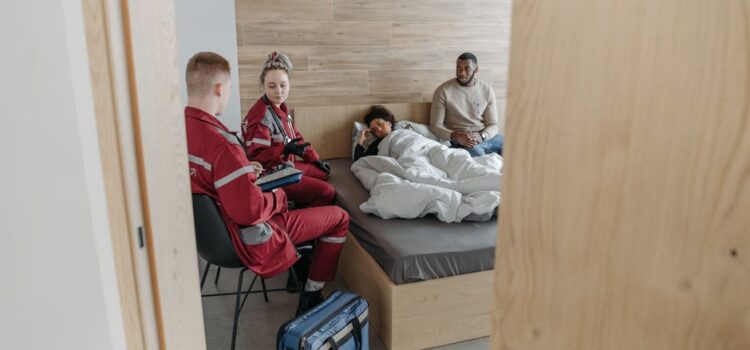
The diagnosis lands, or the call comes, and from that moment forward you are running on a different kind of fuel. Not food, not rest. Just adrenaline, love, and the sheer refusal to stop. Most parents don’t realize until weeks in that they haven’t slept through the night since before the hospital. The anxiety that follows a serious pediatric diagnosis doesn’t announce itself as a clinical problem. It arrives quietly, as vigilance. As responsibility. As love doing what love does when it’s terrified.
What families rarely hear from anyone in that hospital corridor is that your sleep loss and your anxiety aren’t just collateral damage. Left unaddressed, they erode the very things your child needs most from you: your ability to absorb information, ask the right questions, and stay emotionally present on the hardest days. Understanding why this happens, and what you can actually do about it, matters as much as any treatment plan in the chart.
At Victory by Vivian, we walk with families from the first terrifying days through the long journey that follows. We’ve sat beside parents who are running on three hours of broken sleep, carrying fear they don’t know how to put down. The families we’ve supported, the ones whose stories you can read on our Viv’s Kids page, know what it feels like to be handed something impossible to carry. They also know that no one has to carry it alone.
Why Do Parents Lose So Much Sleep When a Child Is Seriously Ill?
Parental sleep loss during a pediatric medical crisis is driven by hypervigilance, a physiological state in which the brain refuses to stand down. Cortisol and adrenaline stay elevated. The mind loops through worst-case scenarios. Every quiet moment feels like something to monitor rather than something to rest in. This isn’t ordinary insomnia. It’s a protective system doing exactly what it evolved to do.
Research indexed through the National Institutes of Health has found that parents of children in pediatric intensive care units frequently meet clinical criteria for acute stress disorder, with between 30 and 50 percent of parents in these settings reporting symptoms serious enough to warrant clinical attention. Many go on to develop PTSD symptoms that persist long after their child comes home. Yet most receive no mental health support during the hospitalization itself.
The hospital environment makes it worse. Lights, alarms, shift-change noise, and the constant movement of a ward make deep sleep nearly impossible even when a parent lies down. Then they come home. And the hypervigilance follows. The brain has been reconditioned to stay alert, and it doesn’t simply stand down because the setting changed. That’s not weakness. That’s neurobiology doing its job too well.
What Are the Signs That Parental Anxiety Has Become a Health Problem?
Anxiety during a medical crisis is normal. Anxiety that now interferes with your ability to function, retain information, or stay present for your family is something that deserves attention in its own right. The line between the two isn’t always obvious when you’re inside it.
Signs worth paying attention to:
- Racing thoughts that don’t slow even in moments of genuine quiet
- Physical symptoms like chest tightness, rapid heartbeat, or shallow breathing with no medical explanation
- Inability to retain what the doctor said, even when you were standing in the room
- Irritability or emotional flatness that wasn’t part of who you were before the crisis
- Appetite changes, either barely eating or eating compulsively to cope
- A feeling of watching events from outside your own body, like you’re dissociated from what’s happening
- Persistent dread on your child’s good days, a sense that something terrible is still coming
That last one deserves a name. Many parents describe what’s sometimes called anticipatory grief, a state in which relief never fully arrives because the fear of the next crisis fills the space immediately. A good lab result brings thirty seconds of exhale before the worry rushes back in. Recognizing this pattern is the first step toward getting some distance from it.
“Anxiety disorders are among the most common mental health conditions in the United States, and caregivers of children with serious illness are at significantly elevated risk. Unaddressed caregiver anxiety can compromise both the parent’s own health and the quality of care the child receives over time.”
How Does Sleep Deprivation Change the Way You Parent?
Sleep is not a luxury you can defer until things settle down. It’s the biological process through which your brain consolidates memory, regulates emotion, and metabolizes the stress hormones that built up during the day. Without it, your capacity for every part of what a medically complex child needs from you, including sharp advocacy, clear decision-making, and emotional presence, is genuinely compromised. Not because you’re not trying hard enough. Because a depleted system runs depleted.
The effects show up in ways parents frequently blame on themselves. You forget what the doctor said five minutes after leaving the room. You snap at your partner. You read the discharge instructions three times and still can’t absorb them. None of that is failure. It’s what sleep deprivation does to a functioning brain.
“Sleep deficiency is linked to an increased risk of heart disease, kidney disease, high blood pressure, diabetes, and stroke. It also affects how well you think, react, work, learn, and get along with others.”
Danny Burns, one of Victory by Vivian’s co-founders, has observed this pattern across years of working with families in medical crisis: the parents who accept help with practical tasks, meals, childcare for siblings, transportation, are the ones who find even a few more hours of rest. And those hours change everything downstream.
What Can Parents Actually Do to Sleep Better During a Crisis?
There’s no approach that makes the fear disappear. But there are concrete practices that help your nervous system find a lower baseline, even in the middle of something this hard. Most take less time than a full night of sleep, which is exactly the point.
- Protect a sleep window, not a full night. Three to four uninterrupted hours does more for cognitive function than eight hours of broken sleep. Ask a partner, family member, or support organization to take a shift so you can close the door and actually rest.
- Write down medical questions before appointments. Offloading the mental to-do list reduces the background hum that keeps you awake at 2 a.m. Get it on paper and out of your head.
- Limit information-gathering to specific windows. Researching your child’s diagnosis at midnight rarely provides clarity. It usually provides more fear. Give yourself permission to stop looking until morning.
- Accept concrete help, not general offers. When someone says “let me know what you need,” give them a task. A meal. A school pickup. A pharmacy run. Delegation shrinks the cognitive load you carry into the night.
- Get outside briefly, even just ten minutes. Natural morning light resets circadian rhythms in ways that no supplement fully replicates. It matters more than most parents expect.
- Say the fear out loud. Anxiety that stays inside your head grows louder. The version you speak to another person, a partner, a counselor, a support community, becomes easier to examine and manage.
When Should a Parent Ask for Outside Help?
Sometimes the right move isn’t a breathing technique or an earlier bedtime. Sometimes it’s a licensed therapist, a psychiatrist familiar with medical trauma, or a peer support community that has walked this same road. Knowing the difference matters.
If anxiety is interfering with your ability to participate in your child’s care, or you’re experiencing panic attacks, dissociation, or thoughts of harming yourself, professional mental health support isn’t optional. It’s part of your child’s care plan. You are part of your child’s care team. Most children’s hospitals have social workers and psychologists who see parents. Don’t wait to be referred. Ask for it directly.
Peer support is often just as powerful in a different way. Reading about how Allie’s family navigated their journey, or following what Carson and his parents carried, can remind a parent in the thick of it that other families have survived something this hard and come out the other side. The stories of Hailey and Jacob show that resilience and even joy are possible beyond the fear.
Non-clinical options worth exploring include parent support groups run through children’s hospitals, faith communities, and nonprofit organizations focused specifically on families in medical hardship. These are not substitutes for professional care when professional care is what’s needed. But they fill a real gap when what you need most is someone who understands what it’s like to sit in a waiting room at midnight not knowing what tomorrow looks like.
No parent should have to choose between being fully present for their child and staying intact themselves. The anxiety is real. The sleep loss is real. And the need for support, practical, emotional, and when necessary clinical, is just as real as any medication on the treatment plan. You are allowed to reach out. You are allowed to need help. And you are not walking this road alone. Victory by Vivian exists because the families who carry the hardest things deserve someone walking alongside them, not just at the bedside, but through every step of the journey that follows.